


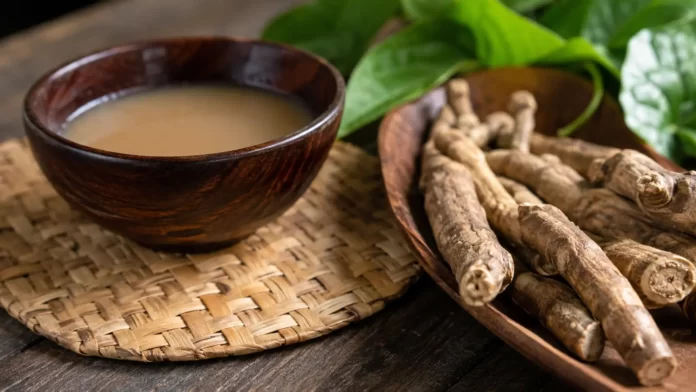
Kava can change how you feel, but Kava is not considered a psychedelic. Instead, it is generally described as a psychoactive plant with depressant effects. It may promote relaxation, reduce feelings of tension, and create mild changes in mood without producing the hallucinations or major shifts in perception associated with classic psychedelics.
The confusion is understandable, as Kava has a long history of ceremonial use in Pacific cultures, and its effects involve the brain and nervous system. However, being psychoactive doesn’t automatically make a substance psychedelic.
So, what exactly does Kava do, and how is it different from substances such as psilocybin or LSD?
What Is Kava?
Kava comes from Piper methysticum, a plant native to the Pacific Islands. Traditionally, people grind or crush the root, mix it with water, and strain it to make a drink. Preparation methods and customs vary by region, and people have used Kava for social, ceremonial, spiritual, and medicinal purposes.
Importantly, traditional Kava is more than simply an herbal drink. Its preparation and consumption have deep cultural significance in Pacific communities, where kava traditions have developed over thousands of years. Modern extracts, capsules, and ready-to-drink products may contain compounds from Piper methysticum, but they shouldn’t necessarily be viewed as equivalent to traditionally prepared Kava.
Kava contains active compounds known as kavalactones that are responsible for many of its effects, like feelings of calm and relaxation.
Is Kava a Psychedelic or Hallucinogen?
No. Kava is neither a classic psychedelic nor generally classified as a hallucinogen.
Psychedelics such as LSD and psilocybin can cause significant changes in perception, thinking, emotions, and a person’s sense of reality. Depending on the substance and dose, people may experience visual distortions, altered perceptions of time, unusual thought patterns, or hallucinations.
Kava doesn’t normally produce this type of experience and is better described as a psychoactive depressant. In this context, “depressant” doesn’t mean that it causes depression. It means that its effects tend to slow or calm activity in the central nervous system.
The easiest way to understand the distinction is that psychedelics are psychoactive, but psychoactive substances are not necessarily psychedelics. Caffeine and alcohol are also psychoactive, for example, but neither is classified as a classic psychedelic.
What Does Kava Feel Like?
Kava experiences vary depending on the preparation, amount consumed, product, and individual. However, the effects are generally much milder than those associated with psychedelic drugs.
People commonly associate Kava with:
- physical and mental relaxation;
- a calmer or less tense feeling;
- mild euphoria or an improved mood;
- greater comfort in social situations;
- sleepiness or feeling ready to wind down;
- temporary numbness or tingling in the mouth when drinking traditional Kava.
These effects can certainly alter how someone feels, which is why Kava qualifies as psychoactive. But feeling calmer or mildly euphoric is very different from experiencing the altered visual and sensory perception associated with psychedelics.
Why Is Kava Sometimes Mistaken for a Psychedelic?
Part of the confusion comes from Kava’s traditional use. Plant-based psychoactive substances have played important roles in ceremonies around the world, and some of these plants are psychedelic. It can therefore be easy to assume that a ceremonial plant must cause hallucinations or psychedelic experiences.
That is not the case with Kava.
Kava has an important place in Pacific cultures and may be used in spiritual, medicinal, recreational, and social settings. Its cultural importance doesn’t depend on it producing psychedelic effects.
Modern marketing can add another layer of confusion, as Kava now appears in extracts, pills, capsules, tonics, and other commercial products. Some products may also combine Kava with other substances, making it important to check exactly what a product contains rather than assuming its effects come from Kava alone.
Kava should also not be confused with kratom. Although the two are sometimes sold or discussed together, they come from different plants and contain different active compounds. Some prepackaged products marketed around Kava have reportedly also contained kratom, further contributing to confusion between the substances.
Can Kava Make You Hallucinate?
Hallucinations are not a typical effect of traditional Kava.
Someone drinking Kava may notice changes in mood, relaxation, coordination, or alertness, but seeing or hearing things that are not there is not considered part of the normal Kava experience.
If someone experiences severe confusion, unusual perceptual changes, or other unexpected symptoms after consuming a product sold as Kava, do not assume this is a normal effect. The product could contain other ingredients, or the reaction could have another cause.
This distinction is especially important with concentrated extracts and mixed commercial products, which may differ significantly from traditionally prepared Kava.
Is Kava Safe?
Kava’s lack of psychedelic effects doesn’t mean it is completely risk-free.
One of the main safety concerns surrounding Kava involves the liver. Kava use has been associated with rare but potentially severe cases of liver injury, including reported cases of liver failure. The FDA has also examined concerns about Kava and liver toxicity, while questions remain about factors such as preparation methods, extracts, doses, product quality, and the use of other substances.
Anyone taking medication or living with a health condition should speak with a healthcare professional before using Kava. Choosing clearly labeled products from reputable sources is also important, particularly because modern extracts and mixed beverages may differ considerably from traditional water-based kava preparations.
So, Is Kava Psychedelic?
No, Kava is not a psychedelic. It’s a psychoactive plant with depressant properties, meaning it can influence mood and the nervous system without normally causing hallucinations or the profound perceptual changes associated with classic psychedelics.
Kava’s relaxing effects and long history of ceremonial use may explain why it sometimes gets grouped together with other psychoactive plant medicines. However, the experience is quite different.
Understanding that difference also makes it easier to approach Kava for what it actually is: a culturally significant Pacific plant with psychoactive effects, a long tradition of human use, and safety considerations that deserve to be taken seriously.