


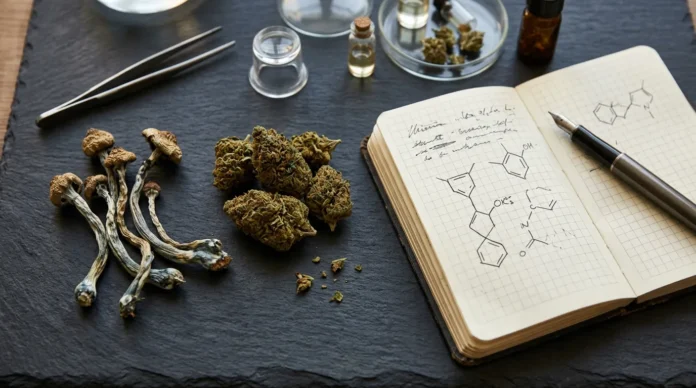
Combining cannabis and psilocybin is one of the most common practices among experienced psychedelic users, and one of the least systematically studied. Anecdotal reports flood online communities with accounts ranging from profound enhancement to overwhelming experiences gone badly wrong. What the science actually says about what happens when these two substances interact is more nuanced than either the enthusiast or the harm-reduction hardliner typically acknowledges.
This article draws on the published research available as of 2026 to give a clear-eyed account of the pharmacological interactions, the risks, and the harm reduction principles that should guide anyone who chooses to combine these substances. For those interested in exploring high-quality cannabis products from a trusted source, the High Society UK review we published covers one of the more reliable options currently available in the UK market.
What We Know About the Pharmacological Interaction
Cannabis and psilocybin operate through fundamentally different receptor systems, which is why their combination produces effects that are neither simply additive nor straightforwardly predictable. Psilocybin acts primarily as a serotonin 5-HT2A receptor agonist, producing its characteristic perceptual and cognitive effects through modulation of serotonergic signalling. THC, the primary psychoactive compound in cannabis, acts on the endocannabinoid system through CB1 and CB2 receptors, with downstream effects on dopamine release, anxiety regulation and sensory processing.
The intersection between these two systems is real and documented. The endocannabinoid system modulates serotonergic neurotransmission in several brain regions, including the prefrontal cortex and limbic system, both of which are central to the psilocybin experience. This modulation means that cannabis does not simply layer its own effects on top of psilocybin: it actively interacts with the neurochemical environment in which psilocybin is operating, with results that depend on dose, timing and individual neurobiological variability.
What the Prospective Survey Research Shows
The most directly relevant published study on this combination is a prospective online survey by Szigeti and colleagues published in 2021, which recruited participants intending to use a classic serotonergic psychedelic alongside varying doses of cannabis. The study found a dose-dependent relationship between cannabis use and scores on the Challenging Experiences Questionnaire, with higher cannabis doses associated with more intense challenging experiences including fear and feelings of insanity. Importantly, the relationship was non-linear: low doses of cannabis were associated with lower challenging experience scores than the no-cannabis group, while high doses produced the highest challenging experience scores.
This dose-dependency is the single most important practical finding from the research: a small amount of cannabis used alongside psilocybin may smooth the experience for some users, while larger amounts significantly increase the risk of a difficult or overwhelming experience.
The Specific Risks of Combining Cannabis with Psilocybin
The main risks of combining cannabis with psilocybin are not the same as the risks of either substance used alone, and they disproportionately affect users who are new to one or both substances, who use high-THC cannabis or who misjudge the timing of their cannabis use relative to the peak of their psilocybin experience.
Anxiety amplification is the most commonly reported adverse effect of the combination. Cannabis in high doses or in anxiety-prone individuals already tends to amplify anxious thoughts. When this effect overlaps with the ego-dissolution and perceptual intensity of a psilocybin experience, the result can rapidly escalate into a panic state that is difficult to manage without external support. This mechanism is particularly pronounced when cannabis is added at or near the peak of the psilocybin experience rather than used at lower doses in the come-up phase.
THC Content as a Critical Variable
The CBD to THC ratio of the cannabis used is a variable that drastically changes the risk profile of the combination. High-THC cannabis strains, which represent the majority of what is available in the illicit market in the UK and Europe, carry a significantly higher risk of anxiety amplification and paranoia when combined with psilocybin than CBD-dominant or balanced strains. CBD has documented anxiolytic properties that may partially counteract the anxiety-amplifying potential of THC, making CBD-rich cannabis a meaningfully lower-risk option for those who choose to combine substances.
Harm Reduction Principles for Those Who Choose to Combine
The evidence does not suggest that combining cannabis and psilocybin is inherently unsafe for all users in all circumstances. It does suggest that the combination carries meaningfully higher risks than either substance alone, and that those risks can be substantially reduced by applying straightforward harm reduction principles.
Dose conservatism is the most important principle. Lower doses of both substances reduce the intensity of the experience and increase the margin for course correction if the experience becomes difficult. This is particularly relevant for cannabis, where the research most clearly shows dose-dependent risk escalation. A first experiment with the combination should use significantly lower doses than one would typically use of each substance individually.
Set and setting matter even more than with either substance alone. The added complexity of the combined experience makes a safe, familiar environment and a trusted companion even more valuable than in a solo psilocybin session. Having a sober trip sitter who is aware of both substances being used and who can provide grounding support is a meaningful risk reduction measure.