


People often ask a simple question: “What’s the strongest psychedelic?”
The real answer is a bit more complicated than just naming one substance.
“Strongest” can mean different things:
- How intense the hallucinations are
- How deeply it changes your sense of self and reality
- How fast it comes on
- How long the effects last
- How overwhelming or destabilizing it can feel
Below is an easy-to-understand overview of the main contenders, how they work, how long they last, what can go wrong, and what research says about potential medical uses.
Nothing here is medical advice, and it’s not encouragement to use illegal drugs. The goal is to inform, not to promote use.
What Do We Mean by “Strongest Psychedelic”?
Most classic psychedelics (LSD, psilocybin, DMT, and mescaline) act mainly on the brain’s serotonin system, especially the 5-HT2A receptor. This changes how the brain processes sensory input, emotion, and sense of self.
“Strength” can be thought of in a few ways:
- Potency by weight (how little you need to feel big effects)
- Subjective intensity (how radically reality changes)
- Depth of ego loss (loss of the usual sense of “me”)
- How disruptive it is to normal functioning
By those measures, psychonauts and researchers usually point to DMT, especially 5-MeO-DMT, as the most overwhelming, with LSD, salvia, and high-dose psilocybin not far behind.
The Main Contenders: Strongest Psychedelics Compared
DMT and 5-MeO-DMT
DMT (N,N-dimethyltryptamine) is found in many plants and is a key ingredient in the Amazonian brew ayahuasca. Smoked or vaped, it can launch users into a vivid, completely alien inner world within seconds. People report:
- Intense geometric patterns and colours
- A feeling of “leaving the body”
- Encounters with seemingly autonomous “entities”
- A total break from ordinary reality
The peak often lasts only 5–15 minutes when inhaled but can feel much longer subjectively. In ayahuasca tea, combined with MAO-inhibiting plants, the effects stretch to several hours and are mixed with nausea, purging, and strong emotional release.
5-MeO-DMT is a related compound found in some plants and in the venom of the Incilius alvarius (Colorado River) toad, as well as in synthetic form. It is often described as:
- Less visual than DMT
- More about total ego loss or “white-out” states
- Extremely rapid and overwhelming
- Capable of dissolving any sense of body, time, and identity
Many people who have tried a wide range of psychedelics describe 5-MeO-DMT as the single most powerful psychedelic they’ve ever encountered.
Addiction & risks:
Neither DMT nor 5-MeO-DMT appears physically addictive. The risks are more psychological and situational: panic, confusion, dangerous behavior if unsupervised, and possible long-term destabilization in vulnerable people (e.g., those with a history of psychosis or bipolar disorder).
Ayahuasca and 5-MeO-DMT also carry physical risks if mixed with certain medications (like MAOIs or SSRIs) or if underlying heart conditions exist.
LSD (Acid)
LSD (lysergic acid diethylamide) is one of the best-known psychedelics and is extremely potent by weight. Tiny doses can produce hours of:
- Intense color enhancement and patterning
- Shifts in time perception
- Emotional amplification (both positive and negative)
- Deep, sometimes obsessive introspection
- At higher doses, partial or near-total ego dissolution
A full LSD trip typically lasts 8–12 hours, which is part of what makes it feel so strong: the altered state just keeps going.
Addiction & risks:
LSD is not considered chemically addictive and doesn’t cause typical withdrawal. However:
- Tolerance builds quickly with repeated use.
- It can trigger anxiety, paranoia, or psychotic episodes in vulnerable people.
- Bad trips can be traumatizing.
- A small number of users report lingering visual disturbances (HPPD).
Medically, LSD and related compounds are being studied for depression, anxiety, and cluster headaches, but this is still mostly in research settings.
Psilocybin (Magic Mushrooms)
Psilocybin mushrooms have been used for centuries in spiritual and healing rituals. The active compound, psilocybin (converted in the body to psilocin), can cause:
- Heightened colors and patterns
- A sense of emotional openness and connectedness
- Changes in thought loops and self-reflection
- In some people, strong mystical-type experiences
Trips generally last 4–6 hours, shorter than LSD but still intense at higher doses.
Addiction & risks:
Psilocybin is not considered physically addictive, and dependence is rare. Major risks include:
- Panic, paranoia, and frightening hallucinations in unsafe settings
- Possible triggering of psychosis in people with underlying vulnerability
- Very real toxic mushroom risk: some deadly species look similar to active ones, which makes foraging dangerous without expert knowledge
On the positive side, psilocybin is one of the most studied psychedelics in modern medicine, with clinical trials for treatment-resistant depression, anxiety, PTSD, and addiction.
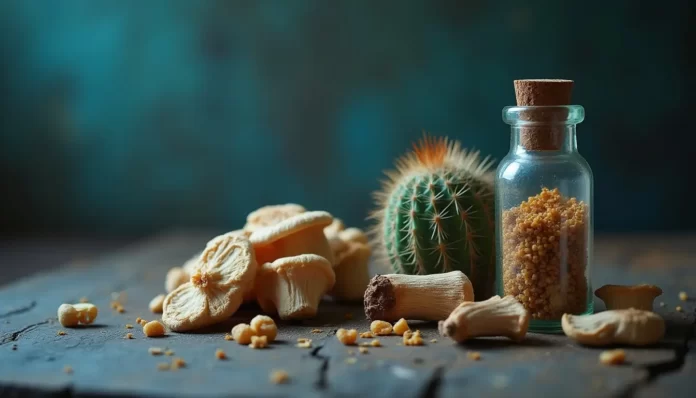
Mescaline (Peyote, San Pedro)
Mescaline is found in cacti such as peyote and San Pedro. Traditionally used by Indigenous peoples in the Americas, it tends to produce:
- Bright, colorful visual patterns
- Changes in body perception and sense of space
- A contemplative, introspective head-space
- Nausea and vomiting (especially with raw cactus)
Effects can last 10–12 hours.
Mescaline is usually considered gentler emotionally than some other psychedelics but still powerful and long-lasting.
Addiction & risks:
Physical addiction is not typical. Main risks include psychological distress, long duration, and (again) problems in people with heart issues or serious mental health vulnerabilities. In many countries, peyote is illegal except for specific religious exemptions.
MDMA (Ecstasy / Molly)
MDMA is often grouped with psychedelics but is actually an entactogen or empathogen. It:
- Releases large amounts of serotonin and other monoamines
- Increases feelings of empathy, closeness, and emotional openness
- Heightens sensitivity to lights, music, and touch
At typical doses, visuals are mild or absent. At higher doses, however, MDMA can cause hallucinations and strong distortions, which is why some people put it on “strongest psychedelics” lists.
Addiction & risks:
Unlike classic psychedelics, MDMA:
- Has real abuse potential (some people binge or use frequently)
- Can cause neurotoxic stress to serotonin systems with heavy use
- Raises heart rate and body temperature
- Can lead to dehydration, overheating, or hyponatremia (from drinking too much water)
- Often produces a harsh comedown, with low mood, fatigue, and irritability
In controlled medical settings, MDMA is being studied and fast-tracked as a treatment for PTSD, but outside supervised therapy, risks are much higher.
How Long Do Psychedelic Effects Last?
Approximate durations (very individual and dose-dependent):
- Smoked/vaped DMT: 5–20 minutes peak, maybe 30–45 minutes total
- 5-MeO-DMT (inhaled): 10–30 minutes
- Ayahuasca (oral DMT + MAOIs): 4–8 hours
- Psilocybin (mushrooms): 4–6 hours
- LSD: 8–12 hours
- Mescaline (peyote/San Pedro): 10–12 hours
- MDMA: 3–6 hours, plus a comedown
Shorter does not mean weaker: smoked DMT and 5-MeO-DMT are very short but often described as among the most intense experiences a person can have.
Negative Side Effects, Addiction Risk, and Safety
Common short-term side effects shared by many psychedelics include:
- Dilated pupils, increased heart rate, and blood pressure
- Sweating, nausea, tremors
- Anxiety, confusion, or panic
- Loss of coordination and poor judgement
Some substances carry specific additional risks:
- MDMA: dehydration, overheating, possible serotonin system damage with heavy or frequent use
- PCP and ketamine (dissociatives, not classic psychedelics): agitation, dangerous behavior, accidents, and, at high doses, seizures or coma
- Salvia: intense disorientation and loss of motor control for a few minutes; unsafe if taken near hazards
Addiction:
Classic psychedelics like LSD, psilocybin, mescaline, and DMT show low potential for physical dependence and do not usually cause compulsive daily use. MDMA and ketamine have a higher psychological addiction risk, especially in party or self-medication contexts.
Mental health risks:
Any strong psychedelic can potentially
- Trigger or worsen psychosis in susceptible people
- Exacerbate bipolar disorder
- Lead to persisting anxiety or depersonalization after traumatic “bad trips”
Screening, supervision, and a safe environment greatly reduce, but do not remove, these risks.
Do Strong Psychedelics Have Medical Uses?
Despite their reputation, several psychedelic drugs are being studied in clinics:
- Psilocybin: depression, end-of-life anxiety, addiction (alcohol, nicotine)
- MDMA: PTSD and possibly other trauma-related conditions
- LSD and related compounds: anxiety, cluster headaches, and potentially depression
- Ketamine (a dissociative with psychedelic-like properties): fast-acting treatment for severe depression
These treatments use carefully controlled doses, medical screening, preparation, and integration therapy. This is very different from unsupervised recreational use.
So, Which Psychedelic Is Actually the Strongest?
If “strongest” means most intense, reality-shattering, and overwhelming, many experienced users and some researchers would point to:
- 5-MeO-DMT as the single most powerful in terms of ego dissolution and sheer intensity
- Followed closely by smoked DMT, high-dose LSD, and potent salvia extracts
If, instead, “strongest” means longest-lasting, LSD and mescaline are clear winners. If it means emotional impact and bonding, MDMA might top the list.
In practice, each psychedelic has its own “personality” and risk profile. Rather than chasing the strongest possible trip, harm-reduction experts consistently emphasise:
- Careful mental and physical health screening
- Respect for set (mindset) and setting (environment)
- Avoiding frequent or high-dose use
- Never mixing unknown substances and never using them alone in risky places