


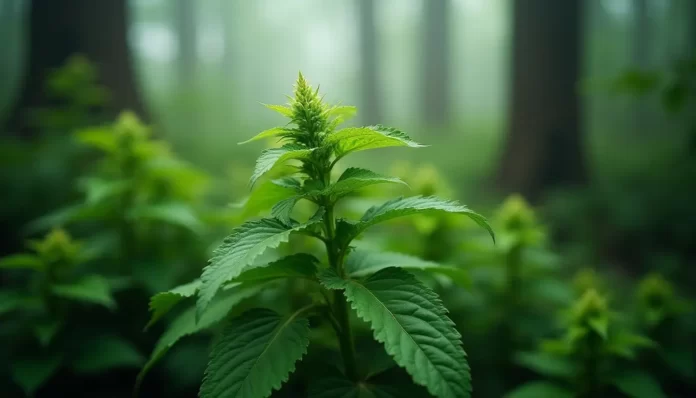
Salvia divinorum is a plant that’s gathered a lot of attention over the past two decades. It has been used traditionally for spiritual practices in Mexico, but also gained media focus in the 2000s when online videos showed people having intense, short-lived hallucinogenic trips.
So, what exactly is Salvia? And is it correct to call it a psychedelic?
This article breaks down the history, effects, chemistry, and classification of Salvia to help answer that question in a clear and balanced way.
What Is Salvia divinorum?
Salvia divinorum is part of the mint family and grows naturally in Mexico. It can reach over one meter tall, with large green leaves and occasional white flowers surrounded by violet-colored calyxes.
Indigenous Mazatec healers have used the plant for generations in rituals focused on healing and spiritual insight. In these settings, fresh leaves are chewed or used to make a drink. The atmosphere is quiet and guided, as the plant is believed to provide wisdom or messages.
Outside its native region, Salvia is most often smoked using dried leaves or concentrated extracts.
What Makes Salvia Psychoactive?
The plant’s effects are caused by a compound called salvinorin A. This chemical is unique because:
- It is not an alkaloid (unlike LSD, psilocybin, mescaline, or DMT)
- It activates kappa-opioid receptors, not serotonin receptors
- It is one of the most potent natural hallucinogens known to science
Salvinorin A takes effect very quickly when smoked, usually within seconds, and the experience lasts only a few minutes before the user returns to baseline. If taken orally by chewing, the onset is slower, and the effects can last up to an hour.
How Does Salvia Affect the Brain?
Most classic psychedelics, like LSD and magic mushrooms, work by influencing serotonin receptors, especially the 5-HT2A receptor. These substances tend to amplify emotions, visuals, and thought patterns while preserving some awareness of reality.
Salvia works very differently. Here’s what makes its effects stand out:
Salvia experiences often include:
- Intense visual distortions or complete dream-like scenes
- Sense of leaving one’s body or merging with objects
- Loss of identity
- Laughter or confusion
- Difficulty moving or speaking during the peak
Many users describe it as feeling transported to a different reality rather than merely altering their perception of the existing one.
So… Is Salvia a Psychedelic?
This depends on how the term “psychedelic” is defined.
Why Some Researchers Say Yes
- It causes hallucinations, altered consciousness, and visions
- It has been used traditionally in spiritual rituals
- It can lead to mystical-style experiences
- It has similarities to DMT and ketamine in inducing powerful mind-altering states
Why Others Say Not Exactly
- It is classified clinically as a dissociative hallucinogen, not a “classic psychedelic”
- It works on opioid receptors instead of serotonin receptors
- The experience can be disorienting rather than emotionally insightful
- It lacks the typical visual and cognitive expansion seen with LSD or psilocybin
In short:
Salvia is psychedelic-like, but it doesn’t fit neatly into the same category as substances traditionally labeled “psychedelic.”
A fair scientific classification is: Dissociative psychedelic or atypical hallucinogen.
Why the Classification Matters
Understanding how Salvia fits into the broader category of mind-altering substances helps with:
- Clearer scientific research
- Better education and harm reduction
- Avoiding misleading comparisons to LSD or psilocybin mushrooms
- Identifying its unique therapeutic potential
Early studies suggest possible medical uses, especially for:
- Treating addiction
- Pain reduction
- Certain digestive conditions linked to inflammation
But more research is needed, as long-term safety data are limited.
Legal Status Around the World
Salvia remains legal in some places, especially where lawmakers see it as a low-risk substance on its own. However, due to concerns about misuse and viral videos encouraging risky behavior, many regions have restricted or banned it.
In the U.S., it is federally legal, but over half of the states regulate or criminalize it to some degree.
Laws are not always consistent:
- Some areas only prohibit selling it to minors
- Others classify it as a Schedule I substance
- Some allow possession but not cultivation
If someone is curious about Salvia, checking current local regulations is essential.
Safe and Responsible Use: What Experts Advise
Researchers emphasize:
- Use only in a safe environment
- Have a sober trip-sitter present
- Avoid driving or swimming before and after effects
- Be aware that confusion and impaired movement are common
Although salvinorin A appears to have low toxicity, frightening psychological experiences can occur, especially if someone is unprepared.
Traditional Mazatec methods involve guidance, intention, and respect, which significantly reduce risky outcomes.
The Bottom Line
So, can Salvia be called a psychedelic?
✔️ Yes, if the definition includes any substance capable of causing visionary or hallucinatory experiences.
❌ Not exactly, because its mechanism, effects, and qualities differ sharply from classic psychedelics like LSD or psilocybin.
A practical definition might be:
Salvia is a unique hallucinogen with dissociative psychedelic characteristics, rooted in ancient spiritual tradition but still not fully understood by modern science.
While it can create powerful and sometimes meaningful experiences, research is ongoing, and responsible, informed use remains essential.